
-
 Paperless electronic processes: The system enables electronic contract signing, preparation of monthly acts, and acceptance of electronic water orders from consumers without paper-based procedures
-
Integration with information systems: Integration with UZCAD, Soliq, CropAgro, and E-ijara eliminates the need for manual entry of consumer data, improves data accuracy
-
Remote water consumption monitoring: Water inspectors in the regions enter daily water consumption data into the system using tablets
-
Unified data and analytics platform: Water consumption, concluded contracts, daily water consumption acts, and operational information at district, regional, and national levels are consolidated on a
Name of the Regulatory and Legal Document:
“On Measures to Increase the Coverage and Quality of Digital Services and to Digitally Transform Sectors, Industries, and Regions”
Reference Number of the Regulatory and Legal Basis:
Resolution No. PQ-162 dated May 24, 2023
System Description:
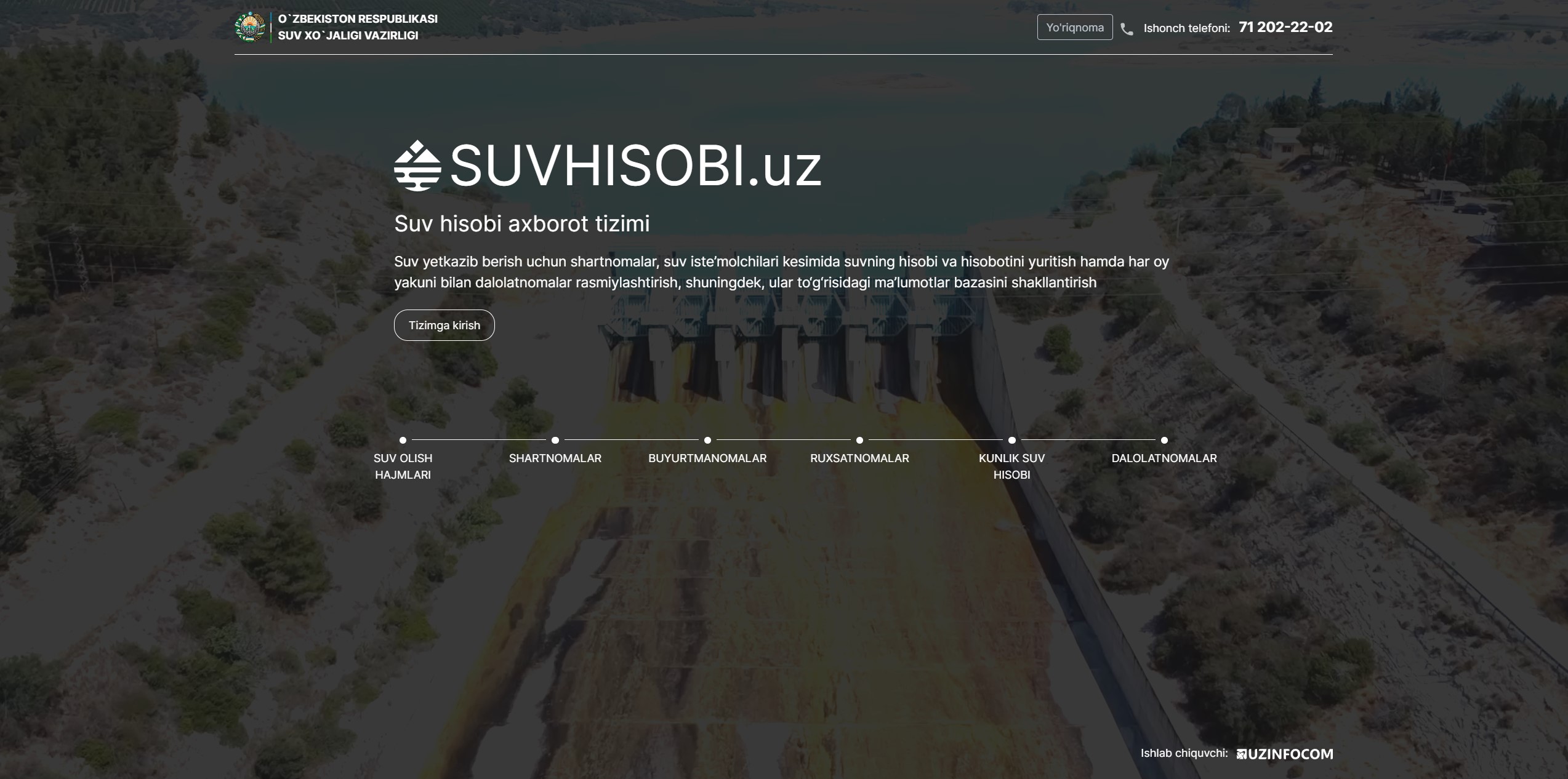
The “Water Accounting” Information System is designed to digitalize water supply processes, automate calculations for consumers, maintain water accounting records, and generate acts documenting the volume of water received by consumers.
The information system is intended for all employees responsible for water supply processes.
Goals and objectives of the system
It serves to promote the widespread use of modern information and communication technologies in the management of water resources in the Republic of Uzbekistan and at infrastructure facilities of the irrigation sector, ensure the efficient use of resources in the water management sector, digitalize economic and financial relations with agricultural and industrial enterprises, improve the effective management of personnel in administrative activities, fundamentally enhance employee productivity and access to information, and significantly reduce the time and material costs associated with daily administrative processes.
Creating a digital database of information related to water accounting and settlements between water users and water consumers, while reducing human involvement in the processes carried out by participating sectors in accordance with laws and subordinate regulatory legal acts;
Digitizing the execution of water supply contracts, applications, reconciliation statements for completed works, and other accounting documents for water users, as well as automating the monitoring of service volumes, payments, accounts receivable, and accounts payable;
Organizing the rational use of water resources in agriculture and systematically regulating water management relations;
Simplifying water distribution and accounting processes in water supply, while ensuring the accuracy, completeness, reliability, and timeliness of data;
Achieving a 50% reduction in expenditures related to labor, communications, transportation, paper, and other resources involved in water accounting;
Ensuring the automated collection of field data and improving its reliability, completeness, and accuracy;
Reducing the administrative burden associated with the preparation, submission, and storage of documents and reports in various formats;
Increasing agricultural crop yields by 15–20% through the rational distribution of water resources;
Establishing systematic control over the timely and high-quality implementation of water supply processes;
Increasing the interest of agricultural producers in implementing industrial and intensive agricultural technologies;
Digitalizing comprehensive measures aimed at ensuring the rule of law and legality in the activities of government bodies, economic management bodies, state enterprises, institutions, and organizations;
Ensuring effective management of the workforce, fundamentally improving employee productivity and access to information, and reducing the time and operating costs of administrative processes by 20–25% through the use of the information system.
Statistics
Statistical data for the last 3–5 years
Number of users: 693,336;
Number of integrated information systems: 9;
Number of external government bodies/participating organizations: 5;
Total volume of operations/transactions: Not available;
Number of website/portal visitors: 693,557.
Key performance and operational indicators
Paper-related costs reduced to zero;
Rational distribution of water resources;
Reduced operational workload of personnel;
Reduced service delivery time (SLA);
Faster financial settlements;
High level of data accuracy and reliability;
Continuous data exchange;
24/7 availability and ease of use;
Unified interactive management dashboard.
-
 Monitoring compliance with established water withdrawal limits
-
Monitoring the status and implementation of water supply contracts
-
Creating, entering, and monitoring acts of completed works
-
Accessing tax reports and reviewing relevant information