

-
 Specialists can apply for professional development courses remotely, select courses, and electronically confirm contracts, which reduces travel and time costs
-
The ability to perform online monitoring and obtain project reports reduces business trips and saves financial resources for organizations
-
Submitting citizen appeals electronically and automatically routing them to relevant specialists significantly simplifies communication with government agencies
-
The ability to promptly report illegal construction increases control efficiency and serves to prevent violations
-
Recommendations on earthquake-resistant housing raise the population's construction culture and reduce damage caused during emergency situations
-
An open map of construction sites allows citizens wishing to purchase housing to obtain reliable and verified information without unnecessary intermediaries
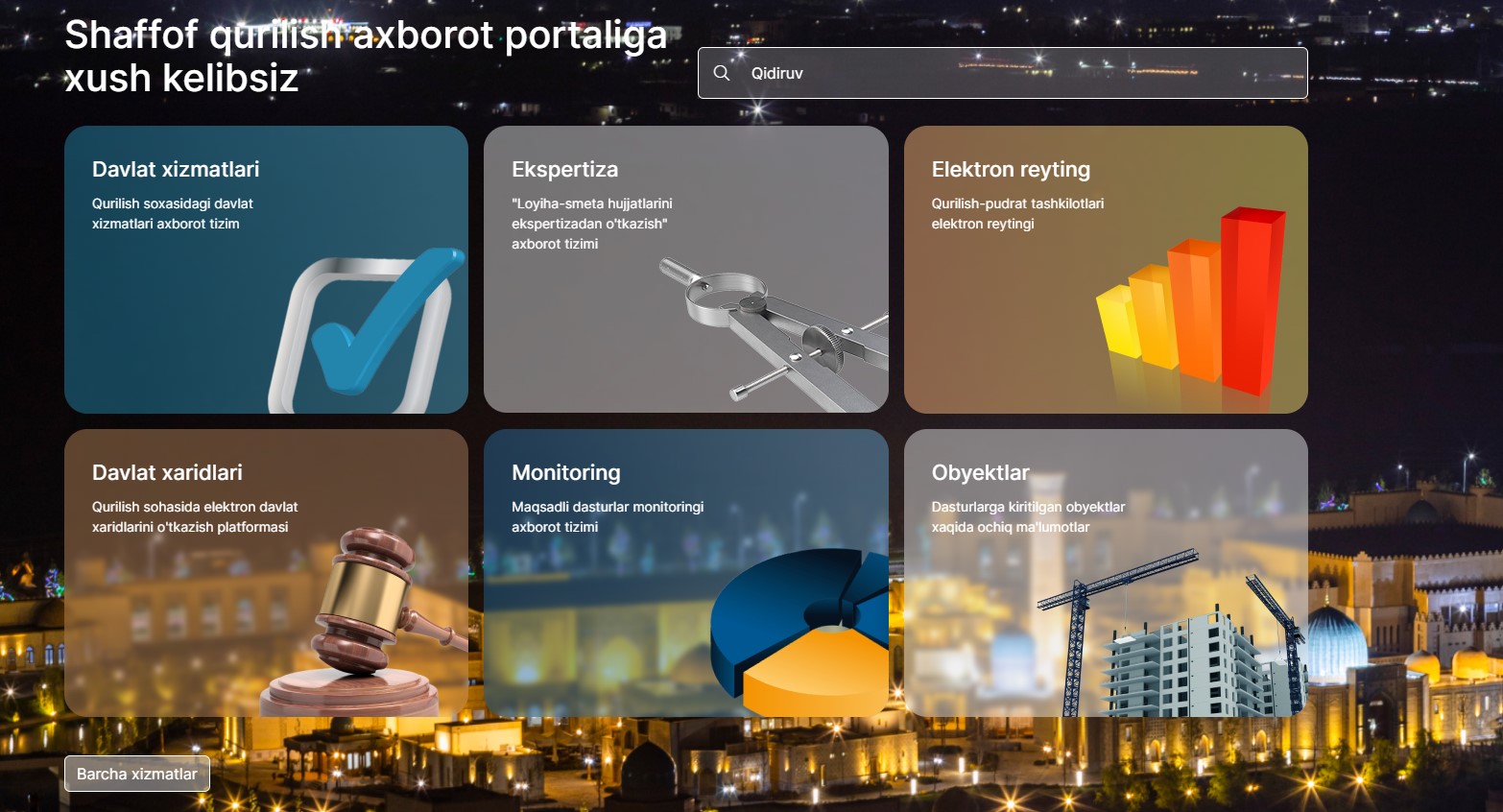
This information system implemented in the construction sector is a comprehensive digital platform consisting of mutually integrated subsystems that fully covers processes from specialist training to controlling construction sites, issuing permits for acceptance and operation of completed objects, monitoring state programs, establishing dialogue with citizens, and providing open data.
As a result of implementing this system, a modern digital management model in the construction industry will be formed, the quality of services will improve, unnecessary time and costs will be reduced, and a strong technological foundation for sustainable and transparent development of the sector will be created.
Online platform "Shaffof Qurilish"
This information system was developed to broadly introduce modern digital technologies into the construction sector, optimize management processes, and ensure effective electronic interaction between government agencies, sector specialists, and citizens.
The main objectives of the system are:
Managing and controlling construction processes in a unified digital environment;
Increasing transparency in the sector and strengthening public control through open data;
Transitioning specialist professional qualification processes to a remote format and reducing the human factor;
Real-time monitoring of the implementation of state programs and investment projects;
Quickly providing citizens with reliable information about construction sites, permits, and inspection reports;
Improving mechanisms for preventing and detecting illegal construction;
Promoting safety standards in construction, including providing information on building earthquake-resistant residential houses;
Reducing unnecessary bureaucratic processes by transferring public services into digital format;
Digitizing and implementing the examination processes of construction and urban planning documentation through a single platform;
Ensuring a unified technological approach when conducting comprehensive expertise of project and technical documentation;
Acceptance and commissioning of completed construction objects and issuing permits for their use.
Electronic tender platform for public procurement in the construction sector
The priority tasks assigned to the system are:
Integrating all information flows in the construction sector into a unified platform;
Implementing digital control mechanisms and automating monitoring processes;
Organizing electronic document management and ensuring data security;
Creating an open, transparent, and reliable information environment for citizens;
Strengthening preventive measures aimed at stopping illegal construction;
Providing government agencies with analytical information and supporting strategic management decision-making;
Monitoring compliance with safety requirements during construction processes;
Forming a model of modern digital management in the field;
Automating the process of conducting mandatory expertise of design and estimate documentation;
Maintaining an electronic registry of documents submitted for examination;
Analyzing technical and financial (estimate) parts of construction projects.
Statistics
Number of users — over 2 million;
Provision of public services in the construction sector — over 1.4 million applications processed;
Expertise of design and estimate documentation — 178,100 expert conclusions issued;
Construction organizations — a rating of 20,910 organizations formed;
Construction management and procurement — 61,726 tenders conducted;
Results of tenders — 3.33 trillion UZS saved.
In order to use the services through mobile applications, you can download from these links:


-
 Online registration, distance learning, and certification of specialists
-
Real-time monitoring, analysis, and generation of reports on the implementation of state programs
-
Receiving, processing, and controlling the execution of citizen appeals
-
Recording violations via photo and video materials and forwarding them to authorized bodies
-
Displaying construction sites on an interactive map based on geolocation
-
Enabling remote review of permit documents and inspection findings