

-
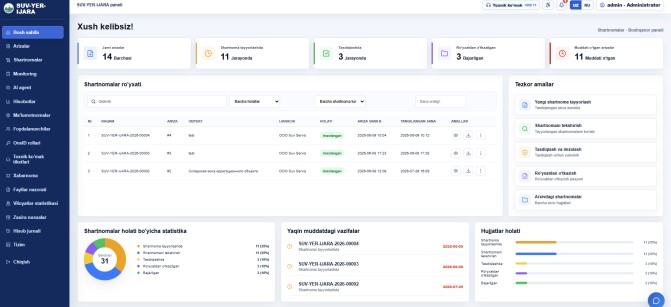
 Unified Digital Management: Managing application submission, approval, contract execution, and monitoring processes on a single platform
-
Transparency and Control: Tracking application statuses, execution deadlines, and actions of responsible employees, while maintaining a history of changes
-
Time and Cost Savings: Reducing paperwork, accelerating document exchange, and automatically generating reports
Name of the Regulatory and Legal Document: Decree of the President of the Republic of Uzbekistan No. PF-99
Reference Number of the Regulatory and Legal Basis: Decree No. PF-99 dated May 26, 2026
The “Water-Land-Lease” Information System is designed to manage the processes of leasing water fund lands, their use, and lease status monitoring through a unified electronic platform. The system is being developed by the Ministry’s Center for Digitalization and Monitoring of Water Management.
The system enables the submission of proposals for leasing land plots, preparation of documents and their electronic coordination with authorized bodies, open access to information on available land plots, organization of electronic tenders, and electronic execution of lease-related documents.
The main users of the system are individuals and legal entities, dehkan farms, business entities, and authorized government bodies and organizations.
The implementation of the system will reduce human involvement and bureaucratic procedures, ensure transparency and openness, centralize data, and improve the efficiency of land leasing and monitoring processes. The system’s functionality is planned to be expanded gradually in the future.
Purpose and objectives of the system
The main objective of creating the “Water-Land-Lease” Information System is to manage the processes of leasing water fund lands, their use, and monitoring through a unified electronic platform, reduce human involvement, ensure transparency, and improve the efficiency of government authorities.
The main objectives of the system are:
Ensuring transparency in the processes of leasing land plots and preventing bureaucratic and corrupt practices;
Automating the collection, review, and coordination of materials related to the leasing of land plots with authorized bodies and organizations — 100%;
Fundamentally improving mechanisms for leasing land plots for farming and commercial purposes, while reducing bureaucratic procedures and barriers in interactions with business entities — 80%;
Ensuring the full use of information and communication technologies in the review and coordination of materials related to land leasing by authorized bodies — 100%;
Creating a centralized database and reducing labor and time costs associated with data collection by 70%;
Achieving an 80% reduction in labor, communication, transportation, paper, and other expenses related to monitoring the status of leased land;
Reducing the administrative burden associated with the preparation, submission, and storage of documents and reports in various formats by 95%.
-
 Submission of applications for available land plots
-
Formation of contracts and ensuring electronic document management
-
Monitoring after the conclusion of contracts
-
Maintaining user information